The rise of the Product Creator
How traditional tech roles are starting to collapse into one.

With AI we can do a lot more with less. What does that mean for the future of the tech industry and our roles?
In the beginning, there was the “web designer.” Then the titles exploded as the industry got its second wind after 2001. The roles mushroomed into Information Architects, Interaction Designers, Visual Designers, UX Researchers, Service Designers, and it didn’t stop there. It was an exciting time with many different specialists coming together to create the future of web and apps. But somewhere along the way the titles started converging.
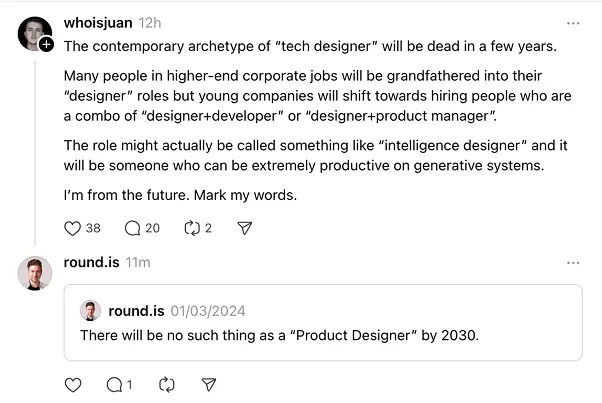
The first convergence came from a vague sounding role of “UX Designer”. Endless debates ensued—see all the memes about how UX is not UI. But there was confusion about what UX Design actually does. Do they also do research, and is this just a title to get away with poor visual or UI skills?
Fast forward. The shift kept accelerating where, in larger companies, Product Designer reigns supreme. Perhaps even more ambiguous in terms of skill sets and what each Product Designer brings, but as part of its requirements, PDs are also expected to bring a business lens to their design and to make sure their design drives outcomes. It’s about shipping outcomes not just pixels.
And today. With AI growing by leaps and bounds I wonder if we’re in some great convergence phase. Do we still need PMs? Do we still need specialist designers? Do we still need engineers? Is everyone cooked, as the kids say these days? Maybe. The nature of work is changing for sure. As an example, I’ve been following Claire Vo, who, as a PM by training, built her own app. Last year at Config I saw solopreneurs iterate their way into successful apps that bring value to customers but are built by them alone.
My belief is that the roles will be more similar than not. Hence the title of Product Creator—someone who has the skills of a product manager, an engineer, and a designer to be just dangerous enough to build a concept and more. Some titles already circulating for this archetype: “member of technical staff,” “design engineer” and interestingly enough the latest I’ve heard was “forward deployed engineer”. I like “product creator” because it doesn’t privilege any one skill.
Due for a shake up
Will Product Creators shake up all the things with vibe code? Probably not. I still don’t trust finance apps that have been vibe coded, or even coded apps by solo founders. How good is their security? I doubt we’ll see vibe-coded banks. Stripe isn’t going away anytime soon. The same goes for industries like healthcare with real security, compliance, and audit requirements. That said, some parts of SaaS and even basic productivity tools can be replicated easily, especially where regulation is light.
Another thing to consider is legacy code. If you’re working inside an existing product with years of accumulated decisions, the benefits of these tools are real but harder to capture. You’re spending most of your energy negotiating with what’s already there. On greenfield work, you start clean. You can invent your own process, ship fast, get feedback, refine.
Looking through the rear-view mirror
There’s a counterintuitive point: experience can be a liability. If you’ve been in the industry long enough, you’ve internalized how things are supposed to work—what the stages are, what roles own what, what handoffs look like. Someone new might just invent their own process because they don’t know they’re supposed to use yours. If they’re still talking to customers and the product is actually solving something, the missing credentials don’t matter. You don’t have to be a technical founder in the traditional sense anymore.
In the end we have to think through first principles.
So bringing this back remember when we talked about ambiguous titles and roles like UX Design? Should UX Designers research, draw wireframes or flows? Maybe. But in the end these artifacts matter much less and what matters is moving the metrics. The way to get this done is through building and picking the right thing to build. Given that builds are much faster and cheaper these days—assuming you already have an audience, you can move much faster than the traditional, classic product build process.
None of this means the specialist disappears. There’s always a place for the deep engineer, the deep researcher, the deep designer, and the problems that require them. The product creator isn’t a replacement; it’s a new position on the board. And right now, for anyone willing to pick up adjacent skills instead of waiting for someone else to staff them, it’s the position with the most leverage.